
29 May 2026
100 days in: Bridging the valley of death
Kathleen Fisher, our new CEO, is 100 days into her role at ARIA
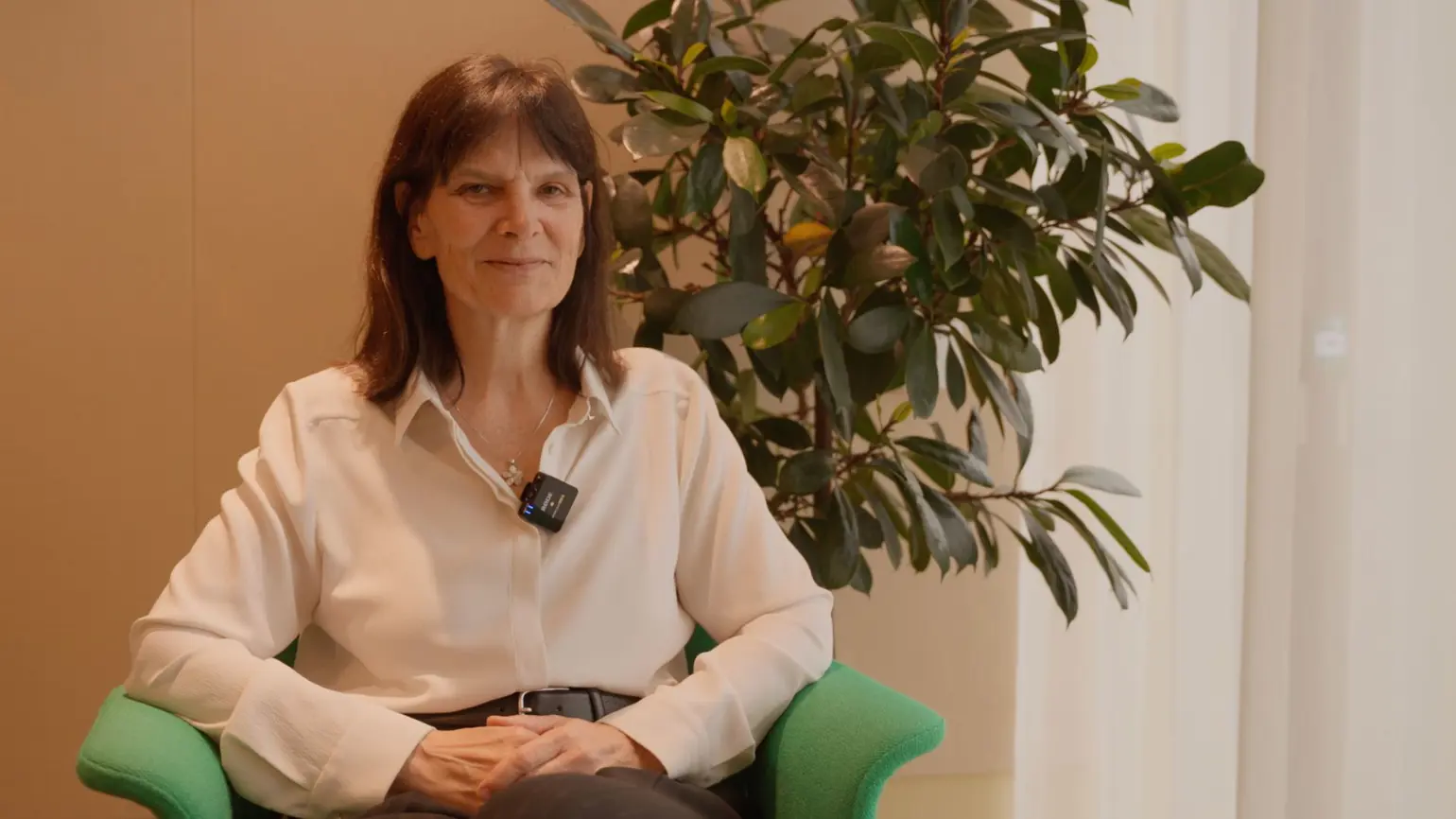
We sat down with Kathleen and asked her what she's learned about ARIA, the UK, and what it actually takes to turn science into transformational societal benefits.
You've had 2 stints at DARPA, plus Tufts and AT&T labs. You've seen R&D from every angle. What does each of those vantage points tell you that the others can't?
One of the advantages of becoming more senior is that you accumulate experience from very different environments. My time in AT&T really made me focus on how important it was to appreciate the outcome of the research – asking not just “is this good science?” but “why does this matter, and what is the real-world impact?”. I arrived straight out of university where I focused on doing research for research’s sake, so landing in an industrial lab where impact was everything was a complete shift. That pivot was transformative for my long-term career. From Stanford and Tufts, I gained an appreciation for world-class research and how it can increase our understanding in a rock-solid way.
At DARPA, I learned the importance of mission – and how a grounded and compelling mission can bring together exceptional people and resources to drive outcomes. In DARPA’s case that mission was national security.
What excites me about ARIA is that all of those elements come together in service of making the UK and the world a better place through science and technology.
Today is your 100th day. What has been your impression so far of ARIA, and the UK?
I’m really impressed with what the UK has set up and what ARIA has accomplished in only three years. The level of ambition I’ve seen across the country is second to none, and the people who are attracted to ARIA are world-class.
That speaks to the UK’s amazing talent base. When it comes to science and technology research, on a per capita basis, the UK is first in the world. On a non-per-capita basis, the UK is third in the world, behind only the US and China, which, for a small country, is pretty incredible.
What’s also struck me is how seriously the people who set ARIA up thought about the structural conditions for long-term success. An important design choice is term-limited leadership and Programme Directors. That continual refresh means you have new people coming in whose ambition is still super high – aiming for moonshot, after moonshot, after moonshot. It also means you get fresh sets of eyes capable of experimenting and approaching decisions with new perspectives, rather than getting stuck in a rut of what the organisation thinks it should be doing.
ARIA is entering a new stage of growth. How do you preserve ambition and the feeling of ‘anything is possible’ as the institution grows?
Growth can sometimes feel like the enemy of ambition – more programmes, more people, more process. But I actually think a larger portfolio creates new opportunities for the kind of unexpected collisions between ideas and disciplines that produce breakthroughs. That's something a smaller ARIA couldn't do.
And the way we manage programmes keeps everyone focused on what matters. We don't fund our researchers by funding them and hoping something works three years later. We are constantly monitoring progress, redistributing resources to the teams that are succeeding, and cutting funding where it isn't working.
The first phase of ARIA was about proving the model. What does success look like for this next phase?
What I think is going to be really important for ARIA over the next years is that we start to show signs of societal impact – not just breakthrough science, but the translation miracles where breakthroughs make it out of the lab and into the world in a way that changes people’s lives.
Every ARIA programme is temporary by design and necessity. We go in, we work on the science, we lay the foundations for translation, and then we leave the field. So the question becomes: who comes onto the field next? Why are they interested? What is the pathway by which you take the science and convert it into something tangible that improves people’s lives?
One thing I've introduced since joining is asking every Programme Director to develop what we're calling an "impact maximisation plan." Those aren't tick-box exercises. They are living strategies to make crossing the valley of death as likely as possible.
You've now met a lot of the UK science and tech ecosystem in your first 100 days. Where do you think the UK research base has distinctive strengths? What’s an interesting tension you have spotted?
The UK science and technology research base is world-class and absolutely fantastic. One of its strengths is that it is a really nice size – you can get people from different disciplines talking to each other in the same room, across researchers, policymakers, funding agencies, and venture capital.
The fact that the UK established ARIA is a really positive sign of wanting to do things differently. There is also an entrepreneurial spirit in the UK that is really encouraging, and a world-class financial centre. The seeds are all there.
The tension I'd call out is one of confidence. The UK has extraordinary scientific potential, but there's sometimes more self-doubt than is actually warranted. DeepMind came out of the UK – that was remarkable. I think if there was a little more willingness to just go for it, we could go even further.
One of the things ARIA does is remove these tensions that could limit ambition or success. A good example is Amodo Design, who are one of our Activation Partners. A Creator in our Forecasting Tipping Points programme needed a modular battery solution to power sensor networks in the ultra-cold Greenlandic environment. Amodo iterated with them three times in three months to get a solution. Without that support, it would have taken at least 18 months. That’s basically the difference between making progress and losing momentum.
Some of ARIA's programmes will not work. That's by design. What's the difference between a programme that fails well and one that fails badly?
Every programme has a North Star and associated metrics for measuring whether you’re getting there. It’s not a problem if you don’t get to the North Star – it’s only a problem if you don’t learn anything in the process. Many of the bold ideas that our Programme Directors pursue will fail – but within that process we're generating new ideas, concepts, and knowledge. And sometimes, as you're chasing one North Star, you end up unlocking a completely different breakthrough. One example is DARPA's attempt to create synthetic blood. The programme manager realised that wasn't going to work, but he realised the same underlying technology might make it possible to create vaccines much faster than previously had been possible. He funded a small effort with a company in Massachusetts. That company was Moderna, and that technology was mRNA vaccines. So was that programme a failure? It didn't reach the moonshot goal of synthetic blood. But it created another game-changing technology.
You come from a computer science background. ARIA has a wide range of programmes that it's tackling. What are some of the ones that you've enjoyed learning about over the past 100 days?
One that is really close to my background is the Safeguarded AI programme, which is focused on whether we can take formal methods-based approaches and connect them with AI to get more confidence in AI-based systems.
AI is obviously game-changing. It’s so flexible and can feel like you’re talking to a human, but it can also do something very stupid or untrustworthy. Formal methods, mathematically rigorous techniques that are used to prove that software is behaving correctly are, in some ways, the epitome of trust, but they are really hard to work with. So the Safeguarded AI programme is asking: can we put these two technologies together to get the best of both worlds as opposed to the worst?
ARIA was born in the AI era. How are you thinking about integrating AI in ARIA’s next chapter?
We are working to ensure UK researchers can access and shape advanced AI capabilities as they develop and mature. One focus for our second cohort of Activation Partners is AI-fluent organisations that can help our Creator base leverage AI across all of their operations. Internally, we are also working to get up to speed with AI across all of our operations, including how to safely use internal AI agents with human oversight.
We are also very interested in how AI can be used to accelerate science. I think the future’s already here, but unevenly distributed. Places where you have a very tight feedback loop – where you can immediately tell “yes, this is right” or “no, that isn’t right” – will go the fastest. That’s places like computer science, maths, automated biolabs, and chemistry labs.
Other areas, where you need to build huge infrastructure or where the data is chaotic, will move much more slowly.
What are you most excited for in your next 100 days?
I'm really excited to travel right across the UK, seeing Creators and their work up close and meeting people from every corner of the ecosystem.
What has surprised you the most since moving to the UK?
How good the weather is – and how much people complain about how bad the weather is.