
30 July 2026
The next companies coming out of UK science: meet Encode Fellowship Cohort 2
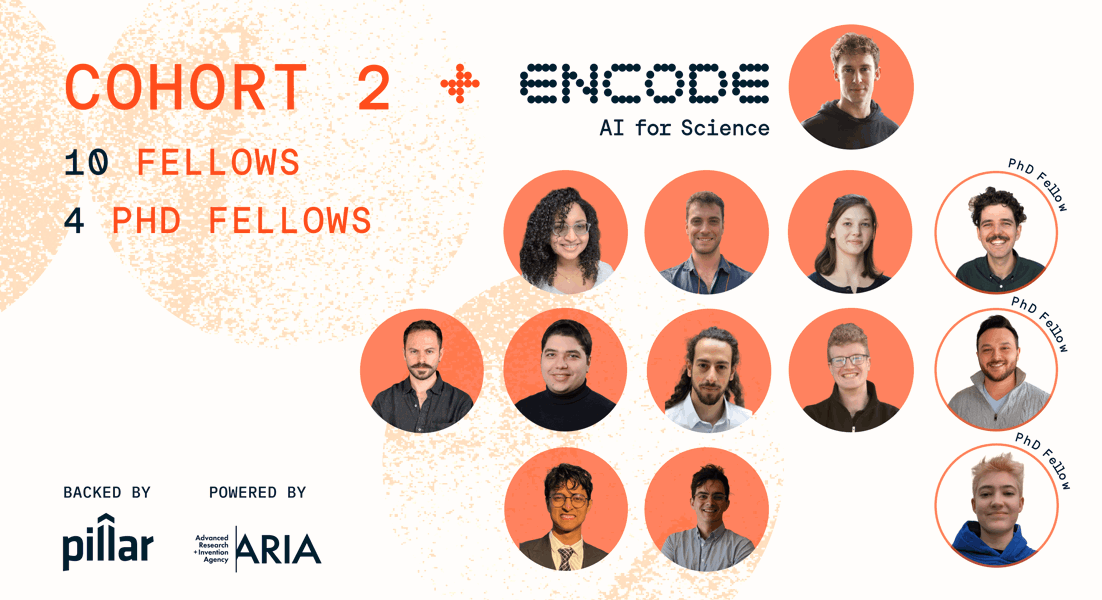
Chosen from over 1,400 applicants across 116 countries, the second cohort of Pillar VC’s Encode Fellows arrives this September with one job: to build.
How do you deliver medicine to the right cells? How do you test thousands of engineering designs without waiting days for each simulation? How do you model climate systems shaped by cascading, nonlinear effects?
These questions sit across very different disciplines. Answering each one takes engineers who can move between advanced AI, experimental science and complex physical systems, and the total freedom to build.
That’s the proposition behind the Encode: AI for Science Fellowship, powered by ARIA and delivered by our Activation Partner, Pillar VC. Today, we’re announcing the second cohort. Learn more about them.
Encode funds exceptional artificial intelligence and machine-learning researchers for a full year. Each fellow gets compute, collaborations with UK scientists and ARIA Creators (the teams and researchers receiving ARIA funding), and hands-on support from Pillar VC and their cohort. The mandate: pursue high-risk, high-reward questions where new technical capabilities could change what science can fundamentally do.
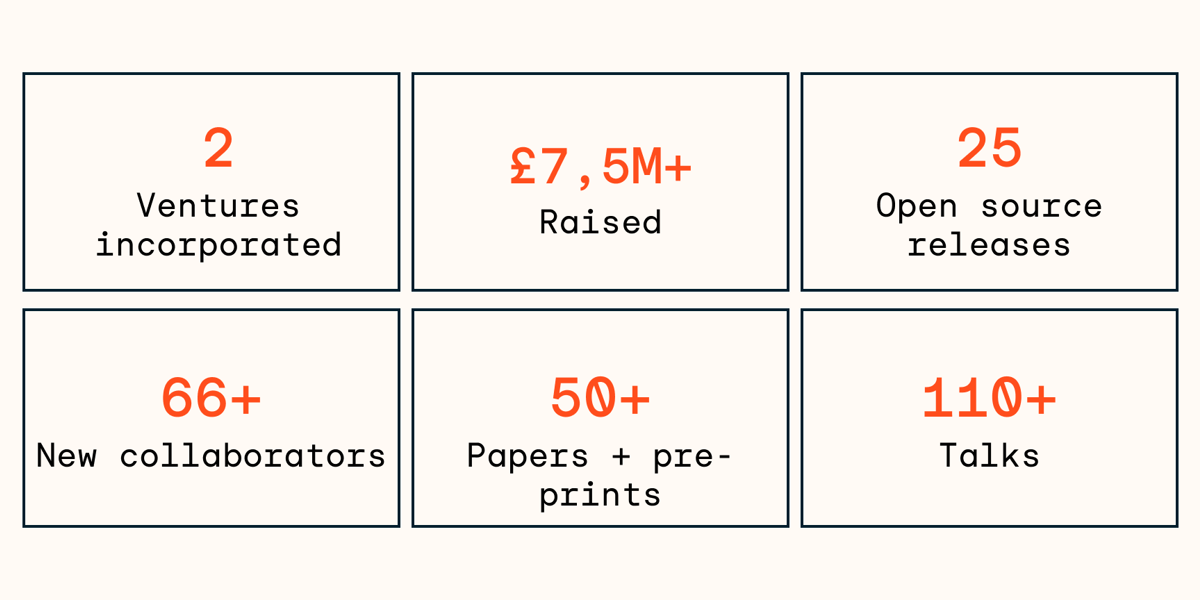
If Cohort 1 is any guide, the work travels quickly beyond the lab: 50+ papers, 25 open-source tools, and two ventures incorporated, with more in the pipeline. Their target is generational impact, for the UK and beyond.
“Encode is about giving exceptional AI talent the freedom to build solutions to scientific problems that really matter – particularly the frontier challenges ARIA is exploring through our opportunity spaces.”
Pippy James
Deputy CEO, ARIA
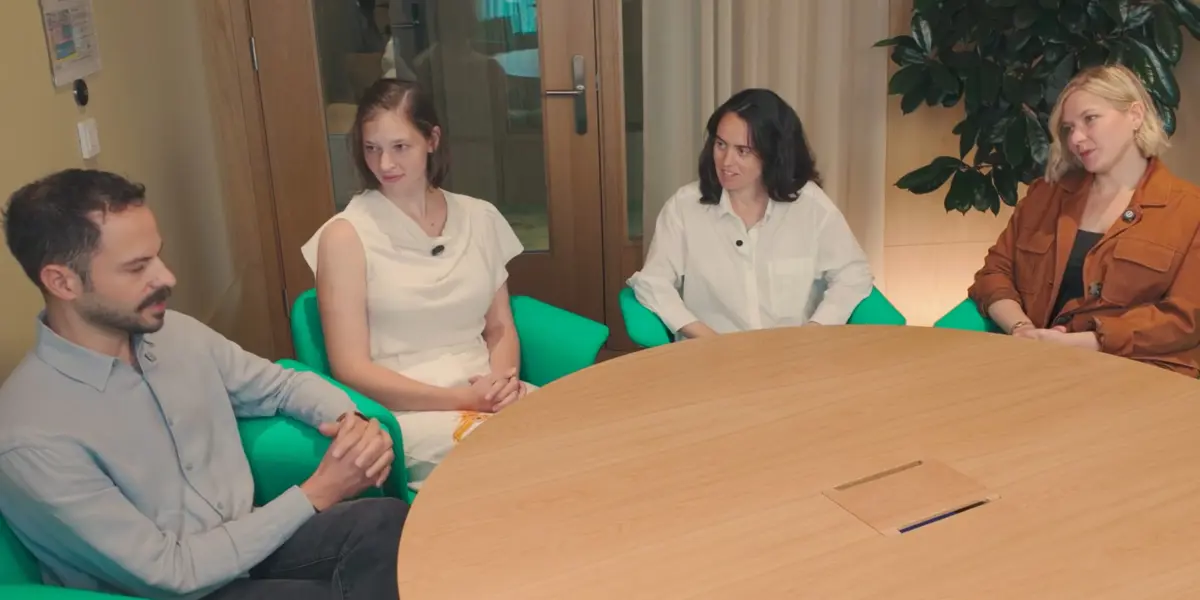
Meet three of the incoming Fellows, Harsh Agrawal, Zack Xuereb Conti and Jacinta May, to understand what being an Encode Fellow enables, and what they hope to build over the next year.
A pathway that doesn’t exist
Many engineers capable of developing advanced AI systems lack access to the laboratories, collaborators and data needed to apply them to frontier science. Meanwhile, UK R&D labs hold frontier data, insights and important scientific problems, but cannot access the AI and ML expertise they need through conventional academic or commercial routes.
Encode closes this gap. It creates trajectories these engineers couldn’t otherwise access, while strengthening the AI capabilities available to UK labs and the UK’s AI for science ecosystem.
“The global pull has been remarkable: four of our Fellows are relocating to the UK for this, and half of all applicants said they'd do the same. World-class talent wants to build here. Encode gives them the path.”
Leah Morris
Executive Director, Pillar VC
The Fellowship combines elements of academic research and company building without requiring every Fellow to follow the same route. Today, 10 Fellows are being announced, alongside 3 of the 4 PhDFellows joining them (individuals who fit Encode’s mission and ARIA’s scope, but who will still be enrolled in UK universities for a portion of their year).
This isn’t a typical incubator. Encode is a catalyst: a year in which Fellows build things they otherwise couldn’t, with collaborators they’d otherwise never meet, or trajectories they wouldn’t otherwise find. Success is work that sustains itself beyond the Fellowship, whether privately funded as a venture, publicly funded as an institution, or living on as an open-source tool, dataset, or benchmark the field adopts.
A new model for collaboration, so Fellows can accelerate science beyond the lab
The Fellowship’s first year has already shown what happens when this kind of talent is given the space to build. The founding cohort has produced 50+ papers and preprints, released 25 open-source tools, and incorporated two ventures, with more in the pipeline.
Cohort 2 brings an even deeper connection to ARIA’s opportunity spaces, and a wider definition of what a ‘collaborator’ can look like, extending beyond leading UK labs into ARIA’s Creator pool, industry, and institutes across the UK.
Over the coming year, the Fellows will test their ideas with collaborators across the country. Their original approaches may not work. Models may fail to generalise, predictions may not survive experimental testing, and new methods may not outperform established ones. But even those outcomes produce useful tools, evidence, datasets and new research directions. And when the approaches do work, they become the foundations of ventures.
We spoke with three of the incoming Fellows, Harsh Agrawal, Zack Xuereb Conti and Jacinta May, to understand what they hope to build and what the Fellowship uniquely enables.
Three Fellows, three technical questions
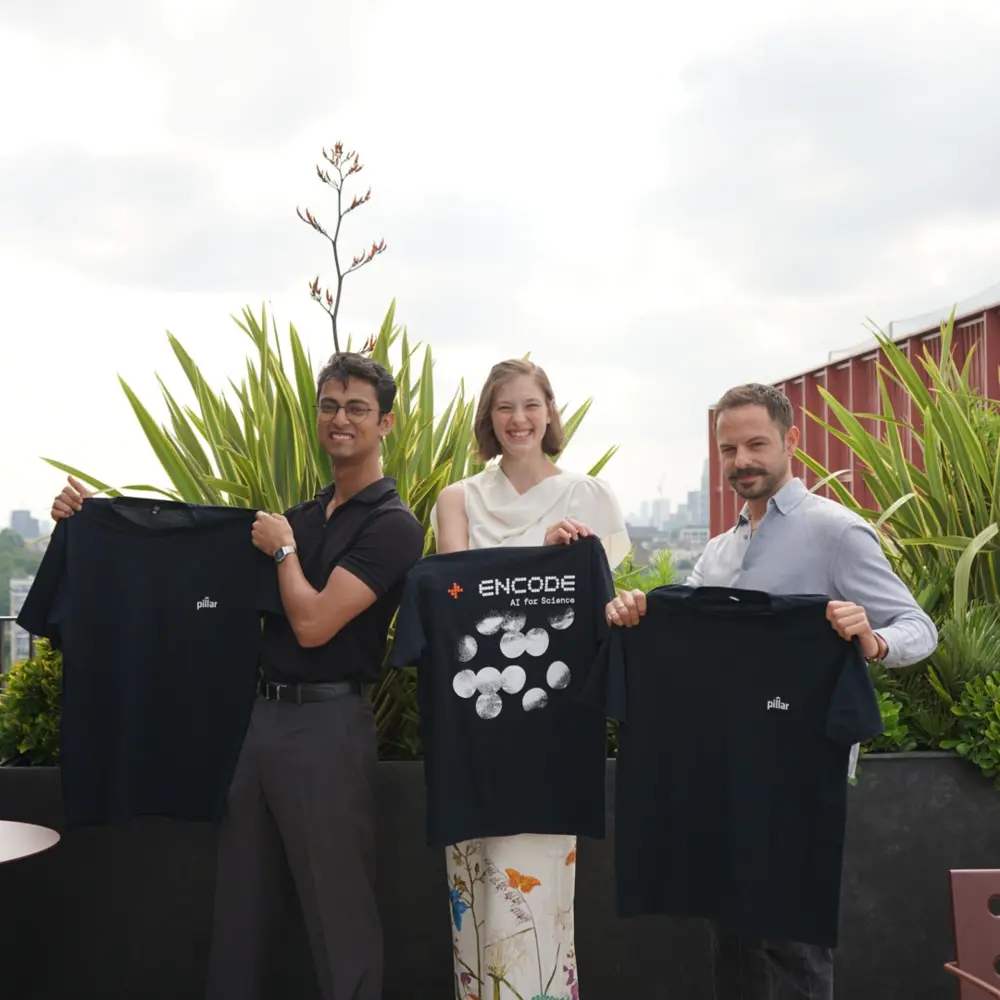
Harsh, Jacinta and Zack celebrate becoming Encode Fellows.
Harsh Agrawal: helping medicines reach the right target
For many advanced medicines, discovering an effective treatment is only part of the challenge. It must also reach the intended cells without causing harm elsewhere.
Collaborating with Professor Dame Molly Stevens’ group at the University of Oxford, Harsh is exploring whether AI can predict how delivery vehicles will interact with cells, organs and the immune system. Better predictions could accelerate the discovery and screening of safer, more targeted delivery systems, a bottleneck shared by the entire advanced-therapeutics industry.
Harsh’s project connects directly with ARIA’s Sustained Viral Resilience programme, which aims to create sustained innate immunoprophylactics: a new class of medicines designed to provide durable, broad-spectrum protection against respiratory viruses by engineering the innate immune system. For these medicines to work, researchers need to deliver an intervention to the right cells and tissues, modulating the immune response precisely without causing unwanted activation elsewhere.
“Within Encode, the only limiting factor is just my work output. I have the compute, I have the collaborations and the incentives to go build whatever I want. It's just a case of how much I can do, and I think that's brilliant.“ Harsh Agrawal
Zack Xuereb Conti: building more general AI models for engineering
Highly accurate engineering simulations can take hours or days to run. AI-based alternatives can be faster, but most are tied to a narrow task or domain and must be retrained whenever the geometry, operating conditions or physical system changes.
Zack wants to build physics-based foundation models for the computer-aided engineering industry: general models that transfer knowledge across engineering systems by exploiting fundamental representations from physical first principles.
Aligned closely with our Safeguarded AI programme, Zack’s project could make engineering simulation faster, cheaper and more trustworthy, helping engineers innovate faster across a market that touches everything from aerospace to energy.
“The Fellowship offers a safe space to fail early, to fail safely, but allow you to regroup, learn and strategise for the next attempt.” Zack Xuereb Conti
Jacinta May: making extreme complexity more legible with frontier quantum
Disorder shapes how heat moves through computing infrastructure, how weather systems develop and how climate risks spread.
Jacinta is building Percene, which combines quantum computing and machine learning to understand and forecast disordered regimes. Her early focus is GPU-dense data centres, a market with an urgent heat and risk problem, with the longer-term aim of building risk-intelligence infrastructure that extends to climate catastrophe and planetary resilience.
Her central question: can quantum machine learning help us understand, predict and act on chaotic physical risks before they happen?
Jacinta’s work aligns with two of ARIA’s opportunity spaces. Scoping Our Planet explores how new sensing, modelling and computational capabilities could help us observe and interpret complex Earth systems more precisely. Future Proofing Our Climate and Weather asks how we might better anticipate extreme events, cascading risks and changing conditions that established models can struggle to represent.
“Only the Encode Fellowship fit the bill for being able to have enough freedom to do what I really wanted to build.” Jacinta May
Accelerating AI for science in the UK
We believe that the UK is uniquely positioned: world-class labs, hungry talent, novel funding, and a government committed to putting AI at the centre of its work to change people’s lives for the better.
Our shared ambition extends beyond each cohort of Fellows to the wider AI for science ecosystem. Over the past year, Encode has supported new tools for scientific discovery, convened thousands of researchers and engineers across the UK, and been cited in the UK Government’s AI for Science Strategy as an example of a new interdisciplinary talent programme.
The Fellowship backs exceptional talent already based here, attracts international researchers to build in the UK, and gives UK laboratories access to advanced AI capabilities. The resulting research, tools, collaborations, and ventures that follow strengthen the wider UK R&D ecosystem and seed the companies that can help reindustrialise the country with AI: good growth, built on British science, reaching every part of the UK.
Encode is a bet on exceptional people before the path is fully obvious, and before much of what’s possible has been proven.