
08 January 2026
Re-thickening Arctic Sea Ice (RASI): Project update, January 2026
Programme Director Mark Symes explains why we're funding outdoor research to gather critical data on the safety and feasibility of sea ice thickening.
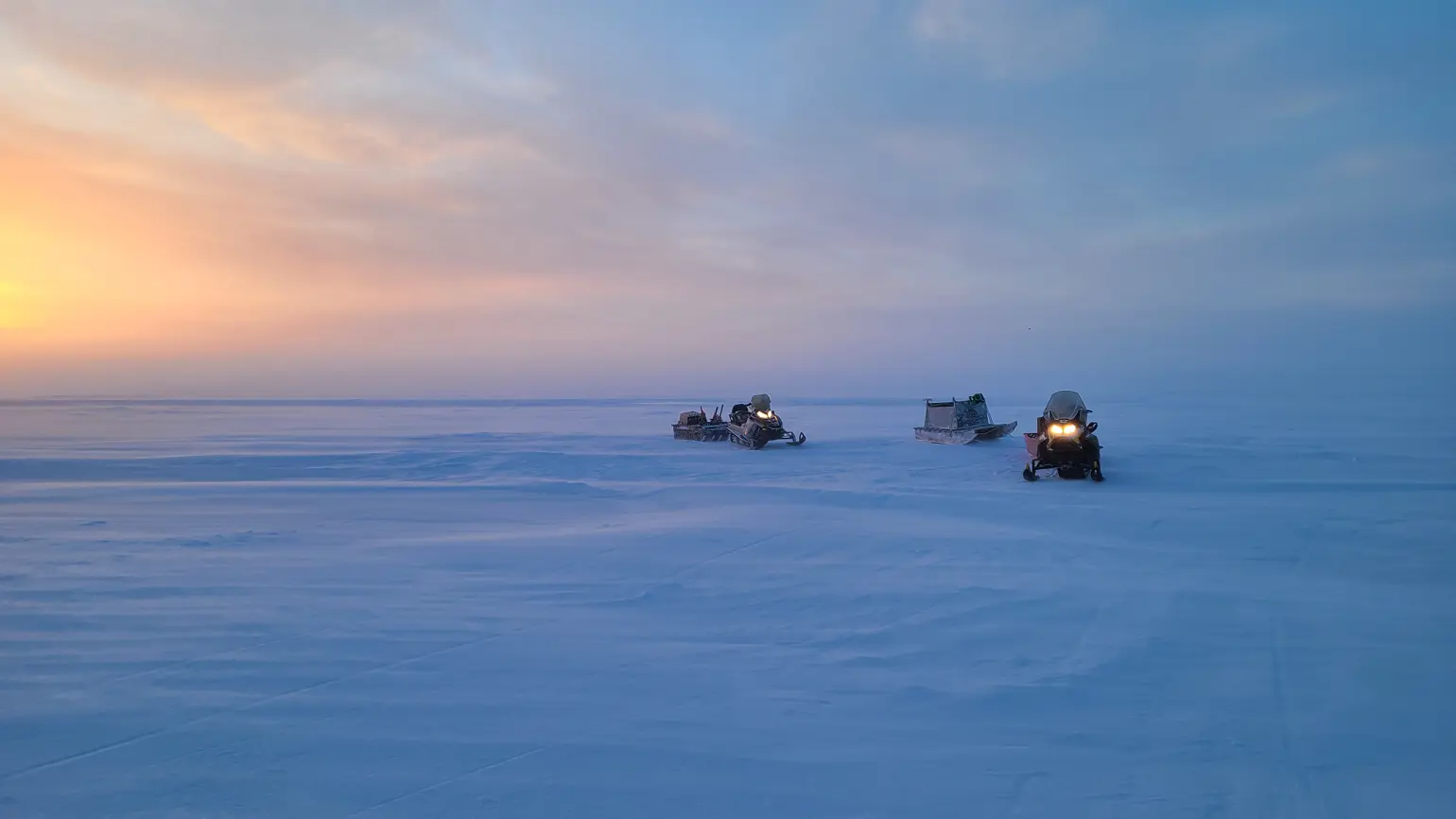
(Real Ice research site in Cambridge Bay, Winter 2024-25, courtesy of Jacob Pantling, Centre for Climate Repair)
The Arctic is in trouble. Whilst greenhouse gas emissions are driving temperatures higher across the planet, the Arctic is warming at roughly four times the global average – October 2024 to September 2025 was the hottest period in the region since records began 125 years ago and ice coverage was the lowest across our 47-year satellite records.
The rapid loss of sea ice strikes at the heart of life in the Arctic: threatening traditional livelihoods and destabilising an increasingly fragile ecosystem. Beyond the region, diminishing Arctic ice cover could trigger significant shifts in weather patterns, with impacts cascading to the UK and around the world. We know what needs to happen to stabilise the Arctic – we must urgently eliminate greenhouse gas emissions. And yet, we may still not act fast enough to stop the Arctic being ice free in summer within the next few decades.
In the face of this rapid warming, climate interventions that might slow down, halt, or even reverse the effects of climate change in the Arctic have been proposed, but we have a limited scientific understanding of their feasibility, safety or efficacy.
As part of our Exploring Climate Cooling programme, ARIA has funded a project called Re-thickening Arctic Sea Ice (RASI) that examines one underexplored climate intervention. Led by the University of Cambridge, the project brings together academic modellers with two specialised field teams — Real Ice and Arctic Reflections — who will conduct outdoor experiments. The aim is to assess the feasibility and potential impacts of trying to artificially thicken sea ice in the Arctic during the cold polar winter to see if that ice lasts longer into the summer months.
Following a period of community engagement and scrutiny by the programme’s independent Oversight Committee, ARIA’s leadership has now approved funding for RASI’s outdoor research in Northern Canada.
The science of sea ice re-thickening
The basic premise behind the RASI project may be familiar, particularly if you have ever skated on a local ice rink or driven on an ice road. The ice formation in both cases works by pumping water onto an existing frozen surface, with the result that the cold air above quickly freezes the water, thickening the ice from the top down.
In the Arctic, the RASI teams will use this same approach. By pumping seawater onto the surface of existing sea ice during the cold winter months, they aim to artificially increase its thickness, potentially delaying its summer melt.
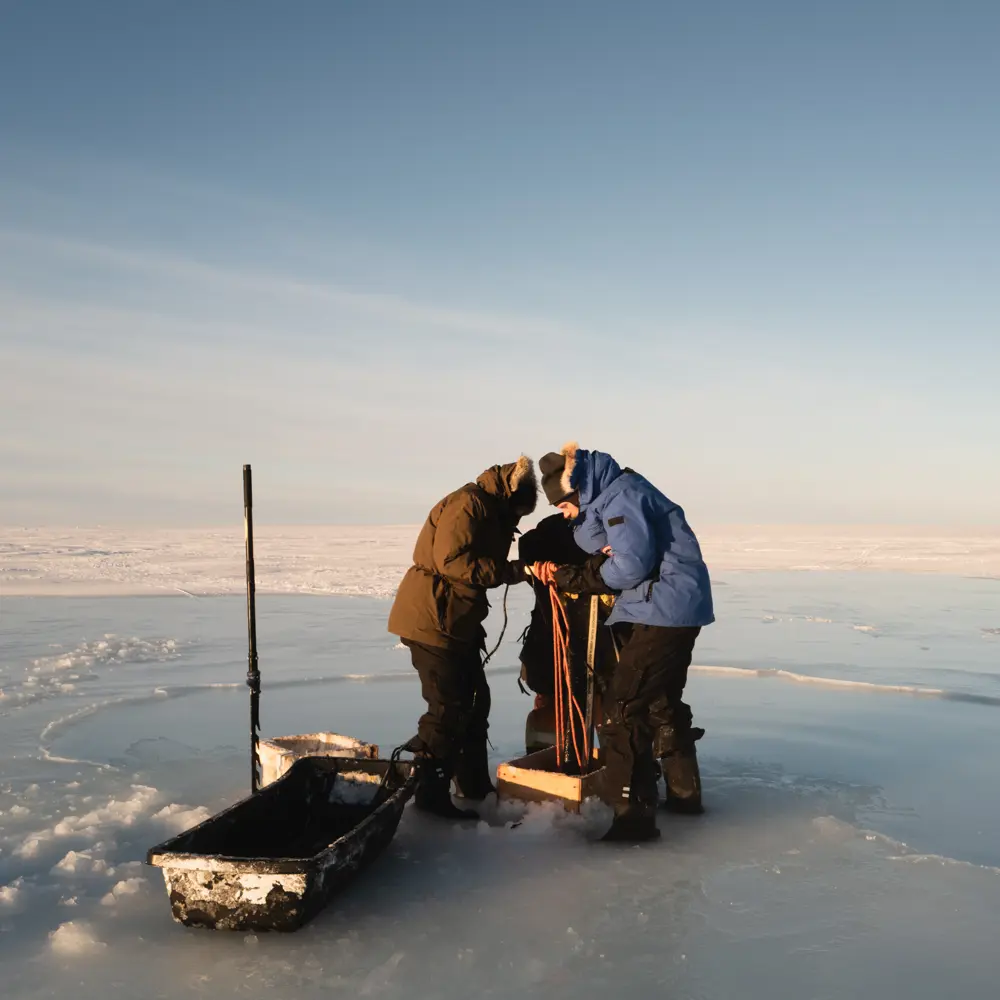
The RASI field teams have previously demonstrated that this approach works at very small scales. Now, with ARIA funding, they aim to examine some of the main scientific questions, such as: how long does the thickened ice actually last into the summer months, what are the strength, salinity profiles, and melt rates of the artificially thickened ice compared to natural ice, and what are the effects on the local ecology of the thickening process?
The RASI outdoor experiments will take place in Nunavut in Northern Canada. The experimental work will be conducted over small, controlled research areas – significantly less than 1km². All activities will take place during daylight hours to reduce disturbance of wildlife, with stringent safety and environmental monitoring protocols in place.
The overarching goal is to learn about the feasibility and potential impacts of ice thickening, and to make that data freely available for rational assessment and scrutiny.
(Real Ice research site in Cambridge Bay, Winter 2024-25, courtesy of Bernard Steffin)
Grounded in community
Community involvement is a non-negotiable for the outdoor experiments in the Exploring Climate Cooling programme, and the RASI teams are committed to working with the people who know this part of the Arctic best: the people who live there.
Both sub-teams have secured Free, Prior and Informed Consent from the communities where this research will take place, and are committed to meaningful, respectful and continuous engagement. Local communities, including the local Elders and the Hunters and Trappers Organizations, have input into the experimental design, local residents will work as part of the research teams, and the RASI field teams will report their experimental results back directly to the communities.
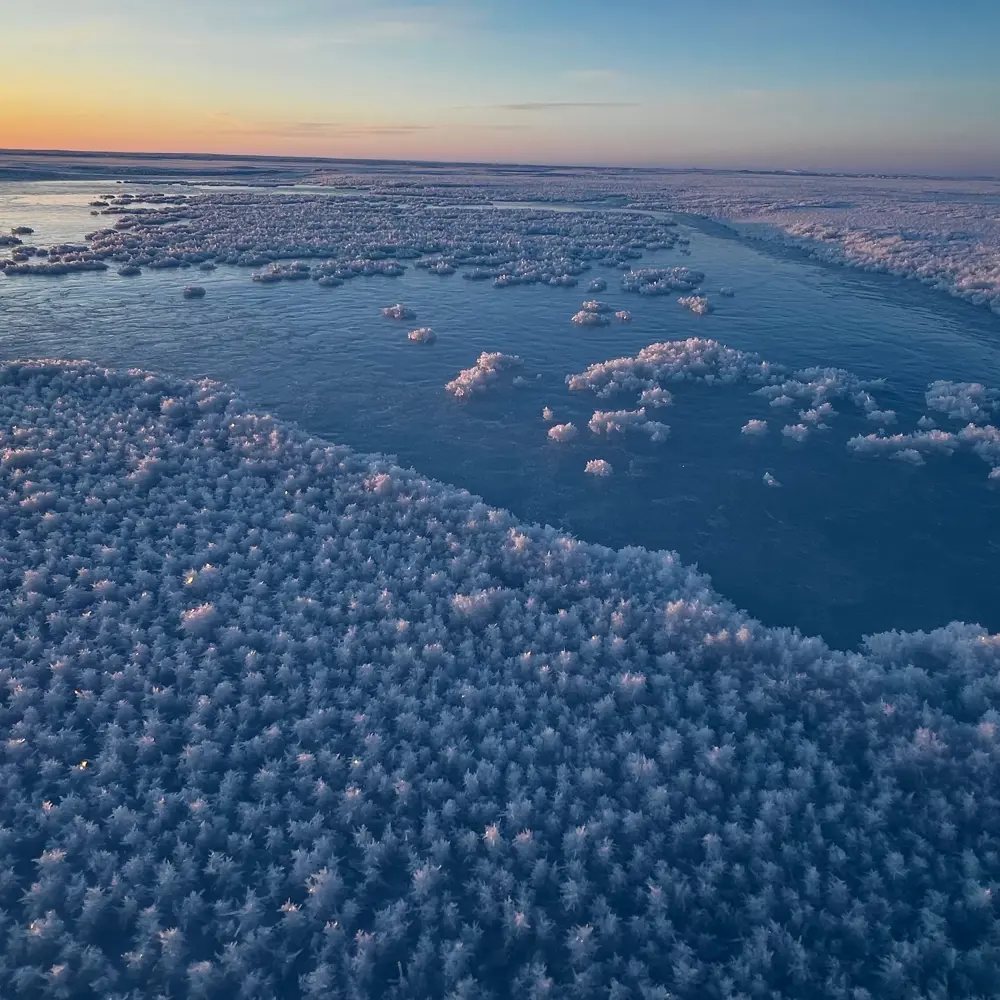
(Real Ice research site showing frost flowers, Cambridge Bay, Winter 2024-25, courtesy of Centre for Climate Repair)
Experiment approval
Nunavut has a well-established mechanism for permitting outdoor scientific research that ensures that this is ethical, responsible, and includes appropriate community engagement. This includes assessment of potential environmental and socio-economic impacts and the incorporation of traditional knowledge. With the support of key local stakeholders, the Real Ice sub-team has been granted a permit to work in Cambridge Bay, Nunavut, and will start work in mid-January 2026. The Arctic Reflections sub-team intends to begin in February 2026, pending the completion of the permitting process. All permits and associated documentation will be shared here, once complete.
ARIA has also assessed the experiment design and the community engagement record as part of our experiment approval process, the formal mechanism by which ARIA commits to funding an experiment. The first step in this process is a thorough review of the team’s plans by ARIA’s independent Oversight Committee. This committee is a panel of external international experts separate from both the project teams and ARIA's programme team. They scrutinise outdoor experiment plans, focusing on scientific value, risk minimisation, evidence of sufficient meaningful engagement and co-design with communities, and consideration of broader implications. Following their review, the Oversight Committee made a formal recommendation to ARIA’s CEO that the experiments could be approved for funding, noting also areas where the plans could be strengthened.
ARIA’s CEO then made a decision to fund the experiments, building on the recommendations of the Oversight Committee. You can read the CEO’s decision letter here and the Oversight Committee’s recommendation letter here. The Oversight Committee and its members remain free to comment publicly on the process and outcome, ensuring transparency and accountability throughout.
An ongoing requirement from the approval process is an obligation on the RASI team to keep the people of Nunavut informed of their work and to maintain the consent of those communities.
Responsible research allows informed, responsible decisions
Projects like RASI are crucial for generating the robust, real-world data that is needed to determine if climate cooling approaches could be feasible and safe. Conducted transparently, with results accessible by all – through open-access repositories – such research could provide the evidence base needed for properly-informed, inclusive and robust decision making. Whilst these experiments on their own won’t “fix” the Arctic, they do represent a determined and committed attempt to explore what might be possible for the common good. We look forward to sharing more as this project progresses.