


Olfactory Perception
Backed by £65m, this programme sits within the Nature-Inspired Computation opportunity space and seeks to build the foundations for general-purpose olfactory perception – matching or exceeding biological systems in programme challenges.
Our goal
While AI systems can already see, hear, and generate complex content, they still cannot access a vast and information-rich part of the world: smell. From identifying disease to preventing the $1 trillion annual cost of food waste, making the chemical world computationally legible could unlock major advances across health, food, and the environment. The barrier is not a lack of sensors, but a lack of shared infrastructure. Unlike vision or audio, the field of digital olfaction is fragmented, with no standardised data, hardware, or representations. We’re seeking to change this by building a unified foundation: a large-scale, cross-domain dataset of chemical signals, new machine learning approaches to understand them, and sensing systems that can apply this knowledge in practice. The ultimate goal is to create a general-purpose artificial sense of smell, matching or exceeding biological performance on defined tasks, and enabling machines to detect and interpret chemical signals in the real world.
Technical Areas
This programme runs for four years and is organised around three Technical Areas, each with its own distinct objective. Together they move from building the shared data foundation, to learning from it, to demonstrating what it makes possible. The first call funds TA1 only.
Open Olfactory Resource
Focused on building and stewarding the Open Olfactory Resource (OOR): the world's largest open, cross-domain dataset of volatile chemical signals, alongside the standards, governance, and organisational infrastructure needed to make it trusted, reproducible, and enduring.
Representations + Sensors
Focused on using the OOR to learn transferable, low-dimensional representations of olfactory space, and to build novel, fast-to-design sensor platforms designed around those representations. (Not currently open for applications.)
Final Challenge
Focused on integrated teams bringing together learned representations and novel sensor platforms to deliver a working, general-purpose olfactory perception system, tested against a biological benchmark on unseen tasks. (Not currently open for applications.)
Technical Area 1: Funding open until 30 September
We're accepting proposals for Technical Area 1: a three-month sprint for up to six teams, each funded by up to £500k, to design and evidence how they would build the Open Olfactory Resource.
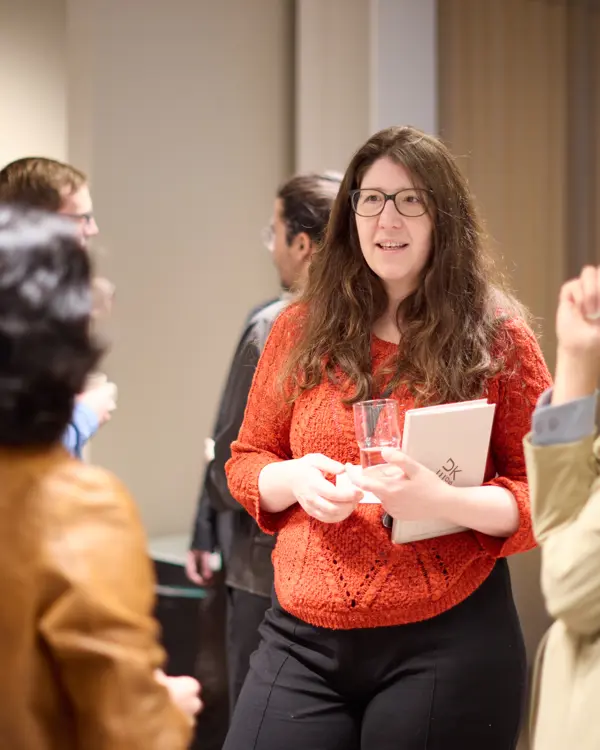
Olfactory Perception: our first funding call
ARIA Substack
Programme Director, Claire Donoghue, reveals the journey towards her first programme.
Meet the programme team
Our Programme Directors are supported by a core team that provides a blend of operational coordination and highly specialised technical expertise.

Claire Donoghue
Programme Director
Claire has worked in AI for two decades in both academia and industry, delivering solutions across healthcare, materials design, manufacturing, and occupational safety. Previously Senior Director in Data Science and AI at AstraZeneca, and before that at 3M, she is an inventor on 19 patents and holds a PhD in machine learning from Imperial College London.

Mike Farrar
Programme Specialist
Mike is a condensed matter physicist by training and joined ARIA from his postdoc at Oxford, where he conducted research on novel photovoltaics. Prior to this, he was responsible for the set-up of several high volume, thin-film deposition operations across the globe for the world's largest electronics original equipment manufacturers. Mike supports ARIA as an operating partner from Pace.

Henry Cerbone
Technical Consultant
Henry is a PhD student at the University of Oxford, conducting research in perception and decision-making across biology and robotics. He completed his undergraduate degree at Harvard University in robotics, biology, and philosophy, and has a Master's degree from Harvard in computer science.
Sign up for programme updates
Receive the latest updates from this programme, including funding opportunities, programme developments, events, activities and ways to get involved.